Sunday, 10 October 2010

Academic Research


Considering the core of this project being about health and how students are ultimately not actively seeking to improve their own, I looked for academic research that could direct my consumer research.
Brown et al (2005) found that “…Students in fraternities and sororities generally had the best nutrient and food group intakes…” (445) which suggests that students eat better and actively seek a healthier diet when eating in groups or societies. This was also advocated through further findings that stated  “breakfast cereals, pasta, and sandwiches may be eaten more frequently by students without a meal plan because they are quick and easy to prepare.” (446). Although this only suggests at the reasoning, they raise an important point. Those who prepare their own meals often fall victim to eating ‘quick and easy’ food (such as shop-bought sauces or ‘microwave dinners’), which more often than not are high in salt and sugar resulting in a poor diet and physical state. Again, Brown et al found themes that supported the notion of group eating: “Significantly more students with than without the meal plan met FGP recommendations for fruit…and meat” (446). Organization and planned eating significantly improves diet and nutrition in student health.
Georgiou et al (1997) carried out a study into the ability of students and non-students to apply the data of nutritional labeling into a healthier diet. They found that “The rate of overweight…among nonstudent women was twice that of female students and four times that of female graduates…Non-students skipped the greatest amount of meals. Students and graduates were most confident of their abilities to use nutrition on labels.” (756). This demonstrated that education clearly play at least some part in eating habits, perhaps students do not require the information on labelling as clearly as first thought because they are already aware of the causes of obesity and what constitutes an unhealthy diet. Conversely, Smith et al (2000) established that “the only consistently observed difference between label users and non-users (male and female) was that users believed in the importance of nutrition information on food labels while non-users did not” (175) and this illustrates that students need to actively take part in learning about food nutrition for them to seek a healthier diet. Kolodinsky et al (2007) found similar results as which established that knowledge of dietary guidelines encouraged the action to eat healthier.
Portion size is a vital aspect of maintaining a healthy diet because it is easy to over measure sizes of ingredients such as pastas or meats. Brown et al (2000) found that education about portion size improves awareness and can therefore lead to better dietary appreciation and health consciousness. Again emphasizing the importance of an education in diet amongst students.
As University is for most the first time they are living away from home, peer influence can play a large part in defining what students eat. Pan et al (1997) found that Asian students studying abroad in the U.S. ate more American food than their traditional cuisine. Culture (both in terms of heritage and your current circumstances) plays a large part in defining how you treat and respond to food. Student will change their habits to ‘fit in’ or assume a figure in the culture they have been adopted into.
According to results found by Ness et al (2002), students are considered unique by marketers as they represent unique circumstances and securing brand loyalty whilst at University could mean a life long dedication to their goods. This is evident in student Union shops through the huge mark down in prices of newspapers. The newspapers see students as a market of the future and by targeting them with a very low cost service at University they can potentially gain a long-term buyer. They also found that students are very brand aware and tend to stick to brands that they are familiar with. This supports the behaviour of marketers as tapping into this market could be difficult but potentially lucrative.

Research Plan

Now I realise that this should have bee uploaded before my competitor research but for some reason it didn't cross my mind that it would be worth putting it on my blog until now.


Research Needed
Competitor research – Highlight concepts of different services currently available and identify how this differs from proposed project. Also identify the technical aspects of the services which aid or hinder it and how these can be improved/altered/adopted to provide a better project. 

Current dietary habits of undergraduate students – Both academically and locally, how do students treat their diets whilst at University? This could include shopping habits, nutritional value of current diet, what services are being used at present, awareness of similar services

Technicalities of concept in a coding sense – What ideas have I had which are potential roadblocks? Is there anything that could be done to easily rectify these issues?

Thursday, 7 October 2010

Competitor Analysis - studentrecipes.com

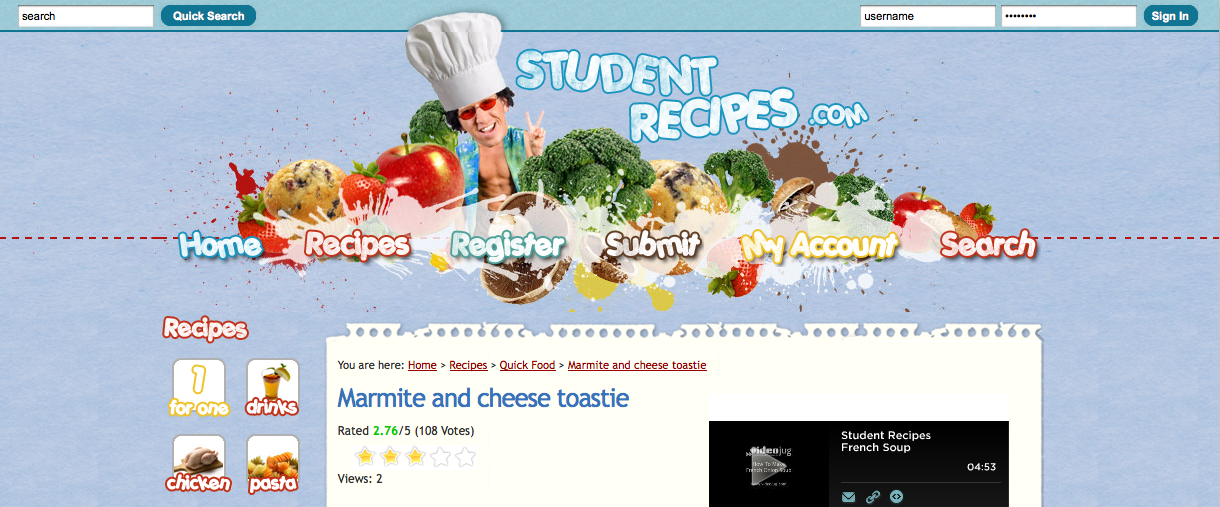
studentrecipes.com is the closest website I have found with a similar objective; student generated content.

Site Description

Their 'about' states that:

"StudentRecipes.Com was originally setup by James Bailey in 2004, when he was a first year student at the University of East Anglia. Since then the website has grown with use generated content and now is visited by 50,000 unique users every month.
As a student himself at that time, he struggled to find recipes that were quick and easy to cook and most importantly cheap. We hope you enjoy using the website and it's growing list of recipes."

In summary, I propose the following are the main technical services that the site offers:
- A portal of recipes uploaded by the community
- A search facility allowing you to refine by recipe title or ingredients
- Register
- Comments facility
  
Similarities and Differences in Concepts

Although the concepts are very similar, there is no abundant message on the website which states that the recipes hosted are those of students. Once browsing the site however, it becomes clear that the recipes are community generated because when you click on 'soups' for example you are fed a table with descriptions such as "Really yummy soup" - hardly a professional description.

Structural Layout


The website is coded using PHP, which is the same language that I will be using to code mine. This means that there could be similar techniques used in both projects, such as the features included on studentrecipes.com

When you first enter the site, it feels slightly cluttered because there is a lot of information being presented. You have sections of the site displayed on the left, A brief welcome statement centrally and a large advertisement on the right hand side. I want my website to contain breathing space for the user so that they are confused about what to do first - there is nothing wrong with designing a website vertically rather than horizontally.

There are preloaded video recipes which are embedded in each recipe page. These are professionally created videos which are not student generated. This is obvious as at the end of each video there are credits and the majority of videos seem to have been filmed in a domestic, family kitchen.

The site doesn't appear to have a proper content hierarchy in place as there are some arbitrary subsections. For example there are categories simply for 'pork' and 'quick'. Surely 'pork' would be under the category of meats rather than mixing it with other (what could be considered 'main') categories? This is certainly something I will try to implement properly - proper organization of sections.

It seems an odd addition to have a link named 'search' as well as an actual search form on the page. Which one should you choose? I presume that the main search form would be quicker so therefore the link in the navigation is an unnecessary addition. Once you click on the 'search' link, you are then directed to a search page. This then gives you four separate links with the word 'search' on them further fueling confusion. The search page you are redirected to also seems to throw out a blank form. When entering a term and then clicking 'search' you are redirected to the same page with no results. Using the newly added search form on the right hand side with options to search through titles or ingredients does seem to provide results however.

Wednesday, 6 October 2010

Competitor Analysis - studentcooking.tv

The next website I will be reviewing is studentcooking.tv - This is a website which offers (according to their 'about' section (I've highlighted the most important parts) -

Site Description

-stylish and informative website that shows students how to cook great tasting, nutritious meals on a budget
-creative ideas for cooking during the student experience
-Students can search for recipes
-online videos, upload videos of their own
-talk about the issues regarding food
-balanced diet
-encourage interaction with our content, building an online community that can enrich and improve young peoples' lives through food"


Similarities and Differences in Concepts

Narrowing down their objectives I propose that they are the following (both technically and conceptually):
- Educate through their recipes the importance of a balanced diet
- Offer creative solutions
- A search facility
- A forum whereby students can talk about food
- Build an ongoing 'project' which is centered around students

Now although my project doesn't aim to target every single one of these objectives, there are definitely similarities. I aim to offer a service which does offer unique recipes not seen in cookbooks or on online recipe hubs as they will be completely student generated. Meaning that some students may eat odd combinations of food but their ideas won't be rejected because that's the concept - student generated and on a budget.

An issue with studentcooking.tv is that they do not offer a rough price to their meals. This means that essentially they can advertise the use of any ingredients which may be out of the budget of students. This is something that I will definitely try to add to the site as it is an essential element to student cooking.

The 'community' aspect of studentcooking.tv is not necessarily something that I aspire to develop. Although there will be user generated content, there is no aim to incorporate a blog or forum into the site - it will be strictly about the recipes.


Structural Layout


The homepage is very busy and provides the user with a lot to take in initially. So much so that the navigation is actually difficult to identify at first until you have properly scanned the screen. This lack of clarity is something which needs to be reversed in my project as I want users to be able to quickly identify possible recipes and get cooking without the hassle of not being able to find one.


On to the 'recipes' page this theme continues as there is a considerable amount of content with not very much 'breathing space'. Although there is a lot to take in, the recipes have actually been ordered very well. There are useful categories which help to break the content down into sub-sections. These are:
-Healthy
-Cheap
-Vegan and Vegetarian
-For Groups
-Posh Nosh
-Your Recipes

These six sub-categories allow for you to quickly locate the theme of what you're looking for without having to decide for yourself which recipe fits your requirements. This simplicity of categorization is certainly an aspect that I must consider as it benefits the user experience greatly and saves time because you are not scanning through reams of text to find what you need.

A very useful addition to the recipe method is the inclusion of photographs which document the making process. Although some of the images used could be seen as an unnecessary extra, it adds a personal touch which makes you feel that this recipe is achievable as a student.

An issue with the architecture of the site is that when a blank search is done there is no acknowledgment of you doing so. You are simply thrown a blank page with no text on it. This will be dealt with when designing my page structure.

Competitor Analysis - supercook.co.uk

Although this website is not a student centered service, it offers useful features which a student could utilise.

Site Description

Their "about" page states the following:

"Supercook wants to make life easier for everyone who cooks at home! Our mission is to enable smarter, quicker decisions about what recipes to make and what ingredients to use using advanced technology and all the recipe content on the web.

...distinct focus on solving the practical problems of modern home cooks: how to waste less food, how to use up perishable or seasonal ingredients, how to keep track of everything in the kitchen, how to save time and money."

Similarities and Differences in Concepts

The major difference here is the mission of both projects. supercook.co.uk target their services to everyone and therefore potential user group is endless. As my project is aimed at undergraduate students only, there is already a huge difference in how both sites should be presented both visually and the tone of voice used.

In spite of those differences though, supercook.com does not lend its style to any specific audience (their aim) so could easily be used by students.

The depth of content/ingredients certainly differs from what I aim to be offering. As stated in the aim, I plan to offer a service which is user generated and not tied to traditional recipes or methods - if students have found successes in odd combinations of flavours then they can upload this for others to enjoy.

Structural Layout


The website is completely dynamic in the sense that all of the main content loads within the page and doesn't cause a page load or redirect. This is a very useful feature as it decreases the time that you spend looking for recipes because they are constantly updated on the right hand side as you input which ingredients you have. The dynamism of the site is a quality which I will certainly consider when designing the architecture of my own website.

One confusing aspect of the site is that there seem to be four alternate ways to search for the recipe. The first is the "add" function which allows you to create a virtual 'list' of ingredients which you have (and therefore updating the recipes generated), the second being the "Do you have?" section of the page. This is essentially a mini list of potential ingredients and by clicking them they are added to your virtual 'list' of ingredients. The third way to search is by using the "Keyword search" located further down the left hand side of the page. This acts as a traditional search form whereby your searched word is scanned against the recipes and then they are filtered accordingly. Finally, the fourth method is by clicking on the "You will also need" ingredients underneath each recipe generated. This will also put this ingredient into your list and at the same time remove it from the "You will need" section of each of the recipes.

These four different methods are individually very useful but when trying to find a recipe you are confused as to which one to use. Do you be specific and search directly which would be quicker? Or do you gradually filter through using the list method? This could perhaps be cleaned up and an alternative search form provided allowing you to choose between one or the other method.

A hidden aspect of the recipes which you only find out once clicked is that they are not stored locally. Each recipe link is a link to another website where the recipe originates. The only real indication of this happening is the link underneath the title which is almost illegible. The site doesn't explain that their recipes are hosted elsewhere which could ultimately confuse users and deter them from entering the site again because it redirects you to other pages - pages which could contain spam or infected content.

Technically, there are a few ways in which this outsourcing of recipes could be achieve. The first being that they are developed a system whereby as the user searches for ingredients, supercook.com scours the internet and outputs relevant results. The second option is that every recipe has been manually inputted into a database hosted by supercook.com and each search is matched against this content. This is most likely to be the actual method they use as the pages load exceptionally fast and perhaps would not do so using the first method. This second method would also reduce the necessary amount of scripting because there would only need to be a database search facility using SQL put in place.

Competitor Analysis - studentcook.co.uk

studentcook.tv is a website that I have previously never used so all of the research with regards to this site will be fresh and unbiased.

Site Description

According to their about us section their service is as follows (selected paragraphs):

"The site caters for the novice cook, with instructions on basic cooking methods and advice on essential items of equipment. It shows you how to eat a varied diet and to make the best use of foods in season.

 Our features and articles are written by experts - who have experience, or a particular interest in this area."

Similarities and Differences in Concepts

Essentially the concept that I am proposing follows the same ambition of catering for  the 'novice cook' in the sense that there will be no pre-requisites - there is no minimum or maximum level of knowledge needed. Where my idea differs however is in the educational side of things. There will not be lessons on how to cook or how to act in certain ways, there will just be the methods described in the recipes to inform the user how each meal is made and not cooking lessons as a whole.

The seasonal aspect of studentcook.co.uk is a real strength as knowing what is in season is an ideal piece of knowledge for students as this produce is cheaper than when it is not in season. This is certainly an aspect which could be applied to my project. Although they advertise this feature in their 'about us', searching through the site did not lead me to any significant indication that they were actually offering the service. Recipes failed to explain which of the ingredients were in season and the closest to a seasonal produce education was via their 'summer salads' and 'winter salads' sections.

Another difference between the two concepts is that studentcook.co.uk state that their recipes are "written by experts" - this is the opposite of what I am trying to achieve, it will be student generated using ingredients students are familiar with, not professional chefs preaching that we use expensive or unavailable ingredients.

Overall the website gives the impression of being a school lesson in food rather than a quick, easy to use student recipe website. There is a lot of content here and the majority of it is descriptive and lacking any true purpose. For example, on the 'cooking beef' page there is this introductory paragraph which generally serves no purpose:

"Beef is pretty simple to cook really and indeed, a good cut should only need the minimum intervention in terms of flavourings and seasonings as the meat should speak for itself. If you're more used to eating beef than actually cooking it then maybe it's time you tried out some simple techniques for yourself. From choosing your cut to feeling your taste buds tingle as the meat sizzles on the grill, it's a very satisfying experience. Below you'll find some classic ways to cook beef - all very straightforward."

This is definitely an issue that I will look to rectify as my project progresses - keep words used down to a minimum and simply illustrate the point without using superfluous language.

Structural Layout


There is a lot of pages on this site and this is supplemented with a huge navigational structure. Every link on the left hand navigation (apart from "Readers Comments") has a secondary menu. The navigation has been named effectively and the secondary navigation does often lead on from the keyword used initially. For example the first layer of navigation has a tab called "How To Cook..." which leads onto the second layer with pages such as "How To Cook Eggs" or "How To Cook Fish". Although this is useful for the average user I do have suspicions of how this would affect users who are using the site with a screen reader. Would the link "How To Cook..." bear any significance out of the context of a secondary visual aid (the second tier of navigation)?

In saying this however, there is a "Sitemap" with every link organised into its first and second layer. This would be very useful for screen reader users - even if there is a huge list of links to be read out.

Tuesday, 5 October 2010

Competitor Analysis

I have chosen to pursue the student generated recipes concept (for now) so the following posts will be centered around the process of carrying out more in-depth competitor research.

Researching around about how to carry out online competitor analysis lead me to some very helpful articles online. One being written on the IBM website located here: http://www.ibm.com/developerworks/webservices/library/us-analysis.html another here written by Adido-Solutions: http://www.adido-solutions.com/resources/articles/website-competitor-analysis.aspx and another written by digital-web.com here: http://www.digital-web.com/articles/competitive_analysis/

I will be using a mixture of the three methods offered by the articles to make sure that the research carried out is sufficient and valuable.

Luis