Here is my updated Gantt chart. The progress that I have made is by including the technical aspects of the project in the fourth image, adding additional mini targets on certain headings and spanning the whole Gantt chart along 24 weeks instead of 12.
Monday, 25 October 2010
Friday, 22 October 2010
Gantt Chart 1st Draft
I have attempted to plan the first 12 weeks of the project for a few of the categories of research that I will be carrying out:
Research Plan
After speaking with my supervisor, we decided that my initial aims are not what I am now working towards.
I now aim to (by means of easy to cook recipes) get more students in the kitchen. This, at the moment, sounds more like a marketing concept than a final year website one so I will need to discover what it is that I actually aim to achieve and complete with regards to the new aim.
As a result of this, my research plan will now have to be updated.
I now aim to (by means of easy to cook recipes) get more students in the kitchen. This, at the moment, sounds more like a marketing concept than a final year website one so I will need to discover what it is that I actually aim to achieve and complete with regards to the new aim.
As a result of this, my research plan will now have to be updated.
Official Research Plan - 1st draft
Research Plan
Competitor Research
In order to substantiate my main concept, I will perform in-depth analyses of existing services aimed at providing recipe ideas for students. I am initially trying to discover what services are available; whether they meet the same criteria I am proposing and whether they do this well. This analysis will take two forms. Firstly, I will perform textual analyses of the websites and seek to find out what technical aspects of the websites both help and hinder the success of the service. As a result of this type of examination, I will be able to draw conclusions about what makes a (technically) successful student recipes website and what does not. Alongside this, I will be in a position to decide whether to include/adapt any of the particularly well-considered technical aspects into my own project. Secondly, I will aim to organise a series of focus groups intended on discovering what potential users of the website feel towards the existing options available. This will prove invaluable to the design of the website both visually and architecturally because what my potential like/dislike with regards to the competition will enable me to formulate a final product that meets their needs successfully.
Consumer Research
As previously mentioned, there will be focus groups organised to gain insights into the target market of the proposed website. Alongside the technical and visual aspects of competitors, I will also look to find out certain habits that the student population have. This is with regards to their shopping and dietary habits as well as their awareness of current available services. As the website will provide recipes with different amounts/types of ingredients, it will be interesting to find out what students currently endeavour to purchase from the supermarket and what levels of spending there are.
Academic Research
The academic research undertaken will provide a necessary framework for the display of information on the website, as well as giving research studies into the themes I will be covering in my focus groups. This will provide me with substantially richer data than if the focus group were to be used alone. The academic research will be carried out into themes such as: existing student dietary trends (what are students eating?), student awareness of health and dietary guidelines in general and the differences (if there are any) in students and non-student eating habits.
Technical Research
This theme will be running throughout the project, as it is potentially the most important piece of research. The main reason for this is my lack of experience in the field of database driven websites. Although I have completed tasks, which do integrate such technical aspects, I have yet to do so with the language PHP. The reason for choosing to code the website in this language is simply down to industry standards and what is most recognised in the field. The research therefore for this aspect will be mainly learning the specific syntax that PHP entails and applying this to the successful completion of the project. If I am presented with potential barriers within the coding sense, I will seek out relevant tutorials or books which will aid my understanding of the problem and provide a way of managing and completing the task.
Sunday, 10 October 2010
Academic Research
Considering the core of this project being about health and how students are ultimately not actively seeking to improve their own, I looked for academic research that could direct my consumer research.
Brown et al (2005) found that “…Students in fraternities and sororities generally had the best nutrient and food group intakes…” (445) which suggests that students eat better and actively seek a healthier diet when eating in groups or societies. This was also advocated through further findings that stated “breakfast cereals, pasta, and sandwiches may be eaten more frequently by students without a meal plan because they are quick and easy to prepare.” (446). Although this only suggests at the reasoning, they raise an important point. Those who prepare their own meals often fall victim to eating ‘quick and easy’ food (such as shop-bought sauces or ‘microwave dinners’), which more often than not are high in salt and sugar resulting in a poor diet and physical state. Again, Brown et al found themes that supported the notion of group eating: “Significantly more students with than without the meal plan met FGP recommendations for fruit…and meat” (446). Organization and planned eating significantly improves diet and nutrition in student health.
Georgiou et al (1997) carried out a study into the ability of students and non-students to apply the data of nutritional labeling into a healthier diet. They found that “The rate of overweight…among nonstudent women was twice that of female students and four times that of female graduates…Non-students skipped the greatest amount of meals. Students and graduates were most confident of their abilities to use nutrition on labels.” (756). This demonstrated that education clearly play at least some part in eating habits, perhaps students do not require the information on labelling as clearly as first thought because they are already aware of the causes of obesity and what constitutes an unhealthy diet. Conversely, Smith et al (2000) established that “the only consistently observed difference between label users and non-users (male and female) was that users believed in the importance of nutrition information on food labels while non-users did not” (175) and this illustrates that students need to actively take part in learning about food nutrition for them to seek a healthier diet. Kolodinsky et al (2007) found similar results as which established that knowledge of dietary guidelines encouraged the action to eat healthier.
Portion size is a vital aspect of maintaining a healthy diet because it is easy to over measure sizes of ingredients such as pastas or meats. Brown et al (2000) found that education about portion size improves awareness and can therefore lead to better dietary appreciation and health consciousness. Again emphasizing the importance of an education in diet amongst students.
As University is for most the first time they are living away from home, peer influence can play a large part in defining what students eat. Pan et al (1997) found that Asian students studying abroad in the U.S. ate more American food than their traditional cuisine. Culture (both in terms of heritage and your current circumstances) plays a large part in defining how you treat and respond to food. Student will change their habits to ‘fit in’ or assume a figure in the culture they have been adopted into.
According to results found by Ness et al (2002), students are considered unique by marketers as they represent unique circumstances and securing brand loyalty whilst at University could mean a life long dedication to their goods. This is evident in student Union shops through the huge mark down in prices of newspapers. The newspapers see students as a market of the future and by targeting them with a very low cost service at University they can potentially gain a long-term buyer. They also found that students are very brand aware and tend to stick to brands that they are familiar with. This supports the behaviour of marketers as tapping into this market could be difficult but potentially lucrative.
Research Plan
Now I realise that this should have bee uploaded before my competitor research but for some reason it didn't cross my mind that it would be worth putting it on my blog until now.
Research Needed
Competitor research – Highlight concepts of different services currently available and identify how this differs from proposed project. Also identify the technical aspects of the services which aid or hinder it and how these can be improved/altered/adopted to provide a better project.
Current dietary habits of undergraduate students – Both academically and locally, how do students treat their diets whilst at University? This could include shopping habits, nutritional value of current diet, what services are being used at present, awareness of similar services
Technicalities of concept in a coding sense – What ideas have I had which are potential roadblocks? Is there anything that could be done to easily rectify these issues?
Current dietary habits of undergraduate students – Both academically and locally, how do students treat their diets whilst at University? This could include shopping habits, nutritional value of current diet, what services are being used at present, awareness of similar services
Technicalities of concept in a coding sense – What ideas have I had which are potential roadblocks? Is there anything that could be done to easily rectify these issues?
Thursday, 7 October 2010
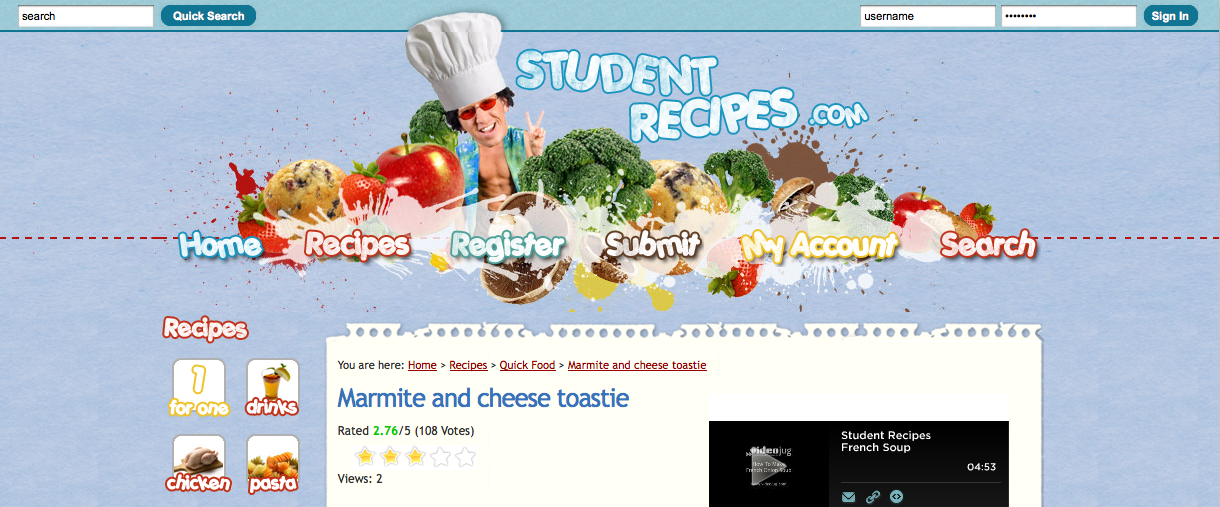
Competitor Analysis - studentrecipes.com
studentrecipes.com is the closest website I have found with a similar objective; student generated content.
Site Description
Their 'about' states that:
"StudentRecipes.Com was originally setup by James Bailey in 2004, when he was a first year student at the University of East Anglia. Since then the website has grown with use generated content and now is visited by 50,000 unique users every month.
As a student himself at that time, he struggled to find recipes that were quick and easy to cook and most importantly cheap. We hope you enjoy using the website and it's growing list of recipes."
In summary, I propose the following are the main technical services that the site offers:
- A portal of recipes uploaded by the community
- A search facility allowing you to refine by recipe title or ingredients
- Register
- Comments facility
Similarities and Differences in Concepts
Although the concepts are very similar, there is no abundant message on the website which states that the recipes hosted are those of students. Once browsing the site however, it becomes clear that the recipes are community generated because when you click on 'soups' for example you are fed a table with descriptions such as "Really yummy soup" - hardly a professional description.
Structural Layout
The website is coded using PHP, which is the same language that I will be using to code mine. This means that there could be similar techniques used in both projects, such as the features included on studentrecipes.com
When you first enter the site, it feels slightly cluttered because there is a lot of information being presented. You have sections of the site displayed on the left, A brief welcome statement centrally and a large advertisement on the right hand side. I want my website to contain breathing space for the user so that they are confused about what to do first - there is nothing wrong with designing a website vertically rather than horizontally.
There are preloaded video recipes which are embedded in each recipe page. These are professionally created videos which are not student generated. This is obvious as at the end of each video there are credits and the majority of videos seem to have been filmed in a domestic, family kitchen.
The site doesn't appear to have a proper content hierarchy in place as there are some arbitrary subsections. For example there are categories simply for 'pork' and 'quick'. Surely 'pork' would be under the category of meats rather than mixing it with other (what could be considered 'main') categories? This is certainly something I will try to implement properly - proper organization of sections.
It seems an odd addition to have a link named 'search' as well as an actual search form on the page. Which one should you choose? I presume that the main search form would be quicker so therefore the link in the navigation is an unnecessary addition. Once you click on the 'search' link, you are then directed to a search page. This then gives you four separate links with the word 'search' on them further fueling confusion. The search page you are redirected to also seems to throw out a blank form. When entering a term and then clicking 'search' you are redirected to the same page with no results. Using the newly added search form on the right hand side with options to search through titles or ingredients does seem to provide results however.
Site Description
Their 'about' states that:
"StudentRecipes.Com was originally setup by James Bailey in 2004, when he was a first year student at the University of East Anglia. Since then the website has grown with use generated content and now is visited by 50,000 unique users every month.
As a student himself at that time, he struggled to find recipes that were quick and easy to cook and most importantly cheap. We hope you enjoy using the website and it's growing list of recipes."
In summary, I propose the following are the main technical services that the site offers:
- A portal of recipes uploaded by the community
- A search facility allowing you to refine by recipe title or ingredients
- Register
- Comments facility
Similarities and Differences in Concepts
Although the concepts are very similar, there is no abundant message on the website which states that the recipes hosted are those of students. Once browsing the site however, it becomes clear that the recipes are community generated because when you click on 'soups' for example you are fed a table with descriptions such as "Really yummy soup" - hardly a professional description.
Structural Layout
The website is coded using PHP, which is the same language that I will be using to code mine. This means that there could be similar techniques used in both projects, such as the features included on studentrecipes.com
When you first enter the site, it feels slightly cluttered because there is a lot of information being presented. You have sections of the site displayed on the left, A brief welcome statement centrally and a large advertisement on the right hand side. I want my website to contain breathing space for the user so that they are confused about what to do first - there is nothing wrong with designing a website vertically rather than horizontally.
There are preloaded video recipes which are embedded in each recipe page. These are professionally created videos which are not student generated. This is obvious as at the end of each video there are credits and the majority of videos seem to have been filmed in a domestic, family kitchen.
The site doesn't appear to have a proper content hierarchy in place as there are some arbitrary subsections. For example there are categories simply for 'pork' and 'quick'. Surely 'pork' would be under the category of meats rather than mixing it with other (what could be considered 'main') categories? This is certainly something I will try to implement properly - proper organization of sections.
It seems an odd addition to have a link named 'search' as well as an actual search form on the page. Which one should you choose? I presume that the main search form would be quicker so therefore the link in the navigation is an unnecessary addition. Once you click on the 'search' link, you are then directed to a search page. This then gives you four separate links with the word 'search' on them further fueling confusion. The search page you are redirected to also seems to throw out a blank form. When entering a term and then clicking 'search' you are redirected to the same page with no results. Using the newly added search form on the right hand side with options to search through titles or ingredients does seem to provide results however.
Subscribe to:
Posts (Atom)